
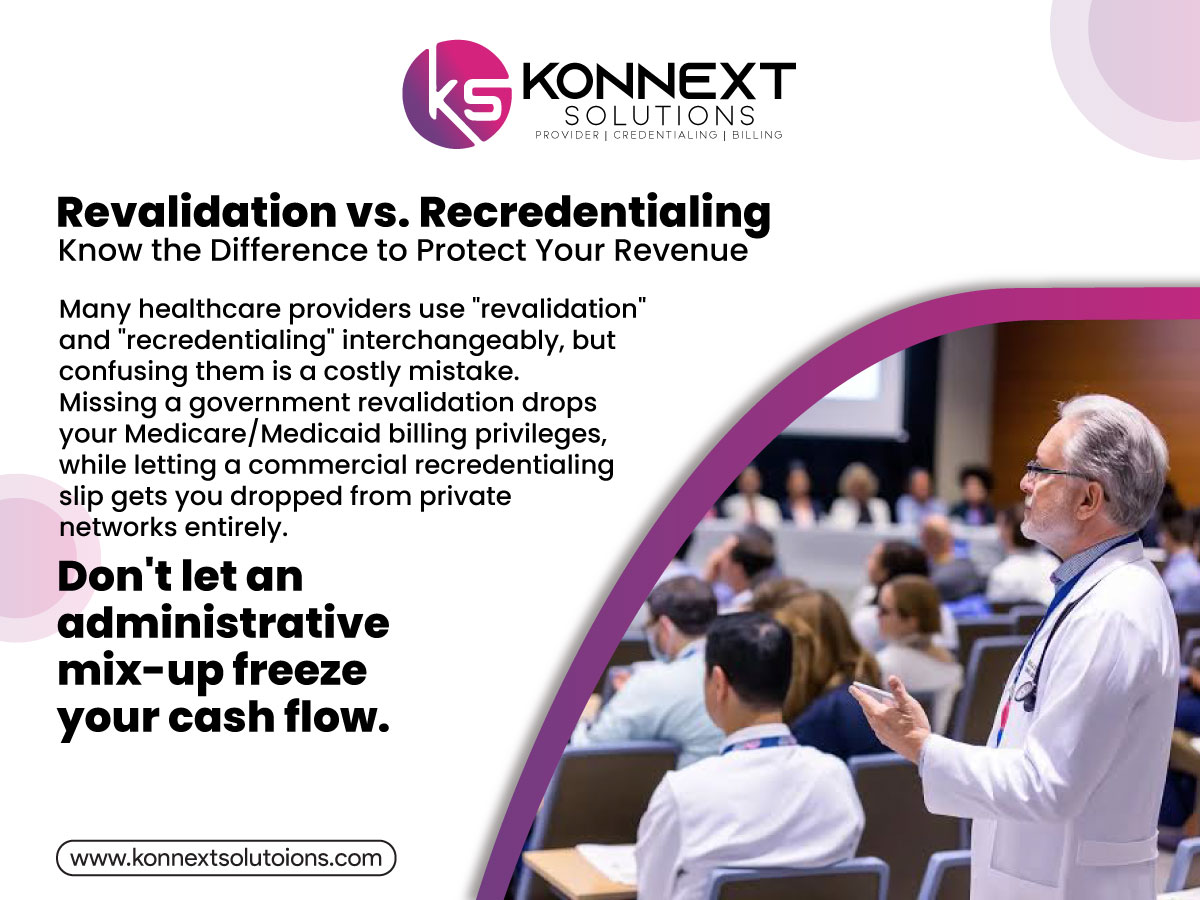
Healthcare providers often hear the terms revalidation and recredentialing used interchangeably. While both processes help maintain a provider’s ability to participate with insurance networks and government healthcare programs, they serve different purposes.
Understanding the difference is essential for avoiding enrollment issues, payment delays, claim denials, and potential termination from payer networks. Whether you are an independent physician, therapist, behavioral health provider, nurse practitioner, or medical group, staying ahead of these requirements protects both your revenue and your reputation.
What Is Revalidation?
Revalidation is the process of renewing your enrollment with government healthcare programs, primarily Medicare and Medicaid. The goal is to confirm that your enrollment information remains accurate and that you continue to meet all program requirements.
The Centers for Medicare & Medicaid Services (CMS) periodically requires enrolled providers and suppliers to revalidate their enrollment information. This process helps maintain program integrity and reduces fraud.
During Medicare revalidation, providers typically verify:
- Practice ownership information
- Practice location and mailing address
- Tax Identification Number (TIN)
- National Provider Identifier (NPI)
- Licensure status
- Contact information
- Managing employees and authorized officials
- Adverse legal actions, if applicable
Unlike an initial enrollment, revalidation focuses on confirming existing information rather than establishing a new provider record.
What Is Recredentialing?
Recredentialing is performed by commercial insurance companies and healthcare organizations to verify that a provider continues to meet participation standards after joining a network.
Most insurance companies require providers to complete recredentialing every two to three years.
During recredentialing, payers review:
- Current medical license
- DEA registration (when applicable)
- Board certification
- Professional liability insurance
- Hospital privileges
- Work history
- Malpractice claims
- Sanctions or disciplinary actions
- CAQH profile accuracy
- Provider performance and quality metrics
The purpose is to ensure providers continue to meet network quality and compliance standards.
Revalidation vs. Recredentialing: Key Differences
| Revalidation | Recredentialing |
| Required primarily by Medicare and Medicaid | Required by commercial insurance companies |
| Confirms provider enrollment information | Verifies ongoing qualifications and competency |
| Maintains participation in government healthcare programs | Maintains participation in private insurance networks |
| Usually initiated by CMS or state Medicaid agencies | Initiated by individual insurance companies |
| Focuses on enrollment compliance | Focuses on provider qualifications and quality |
Although the processes are different, both are equally important for maintaining uninterrupted reimbursement.
Why Missing Either Process Can Be Costly
Many providers assume their credentialing is complete after becoming in-network. Unfortunately, credentialing is an ongoing process.
Failure to complete revalidation or recredentialing can result in:
- Claim denials
- Payment interruptions
- Network termination
- Enrollment deactivation
- Delayed patient care
- Time-consuming reinstatement processes
For Medicare providers, missing a revalidation deadline can lead to deactivation of billing privileges, preventing payment for services until enrollment is reactivated.
Private insurers may remove providers from their networks if recredentialing requirements are not completed on time.
Common Challenges Providers Face
Managing multiple payer deadlines can quickly become overwhelming, especially for practices participating with numerous insurance companies.
Some of the most common issues include:
Missed Renewal Notices
Many payers send notices by mail or email months before deadlines. If contact information is outdated, providers may never receive them.
Incomplete Documentation
Expired licenses, missing malpractice certificates, or outdated CAQH profiles frequently delay approvals.
CAQH Maintenance
Many commercial payers rely heavily on CAQH data during recredentialing. An outdated CAQH profile often results in processing delays.
Staff Turnover
When office managers or credentialing staff leave, important deadlines can easily be overlooked.
Best Practices for Staying Compliant
Maintaining compliance requires a proactive approach rather than waiting for notices to arrive.
Healthcare organizations should:
- Maintain a credentialing calendar with renewal dates
- Keep CAQH profiles updated and attested regularly
- Monitor Medicare revalidation due dates
- Track license and certification expiration dates
- Store credentialing documents electronically
- Conduct periodic internal audits
- Assign responsibility for ongoing credential management
These simple practices help prevent costly interruptions.
How Credentialing Management Improves Revenue Cycle Performance
Credentialing is closely connected to revenue cycle management.
When provider enrollment remains active and credentialing records stay current:
- Claims process faster
- Fewer denials occur
- Cash flow improves
- Administrative workload decreases
- Patient scheduling becomes more efficient
On the other hand, credentialing lapses often create avoidable revenue losses that take months to resolve.
How Konnext Solutions Supports Healthcare Providers
Managing credentialing requirements across multiple payers can consume valuable administrative time.
At Konnext Solutions, we provide comprehensive credentialing support, including:
- Medicare and Medicaid revalidation
- Commercial insurance recredentialing
- CAQH profile management
- NPI and PECOS updates
- Payer enrollment maintenance
- Credential expiration tracking
- Ongoing compliance monitoring
- Provider enrollment support for individuals and group practices
Our team works proactively to help providers stay compliant, avoid enrollment disruptions, and maintain uninterrupted reimbursement.
Final Thoughts
Revalidation and recredentialing may sound similar, but they serve different purposes within the healthcare reimbursement process. Revalidation ensures compliance with government healthcare programs, while recredentialing confirms continued eligibility with commercial insurance networks.
Missing either process can result in denied claims, payment delays, and loss of network participation. By maintaining organized credentialing workflows and monitoring renewal deadlines, providers can avoid unnecessary disruptions and focus on delivering quality patient care.
Partnering with an experienced credentialing company like Konnext Solutions can simplify the entire process, reduce administrative burden, and help safeguard your practice’s financial health.