
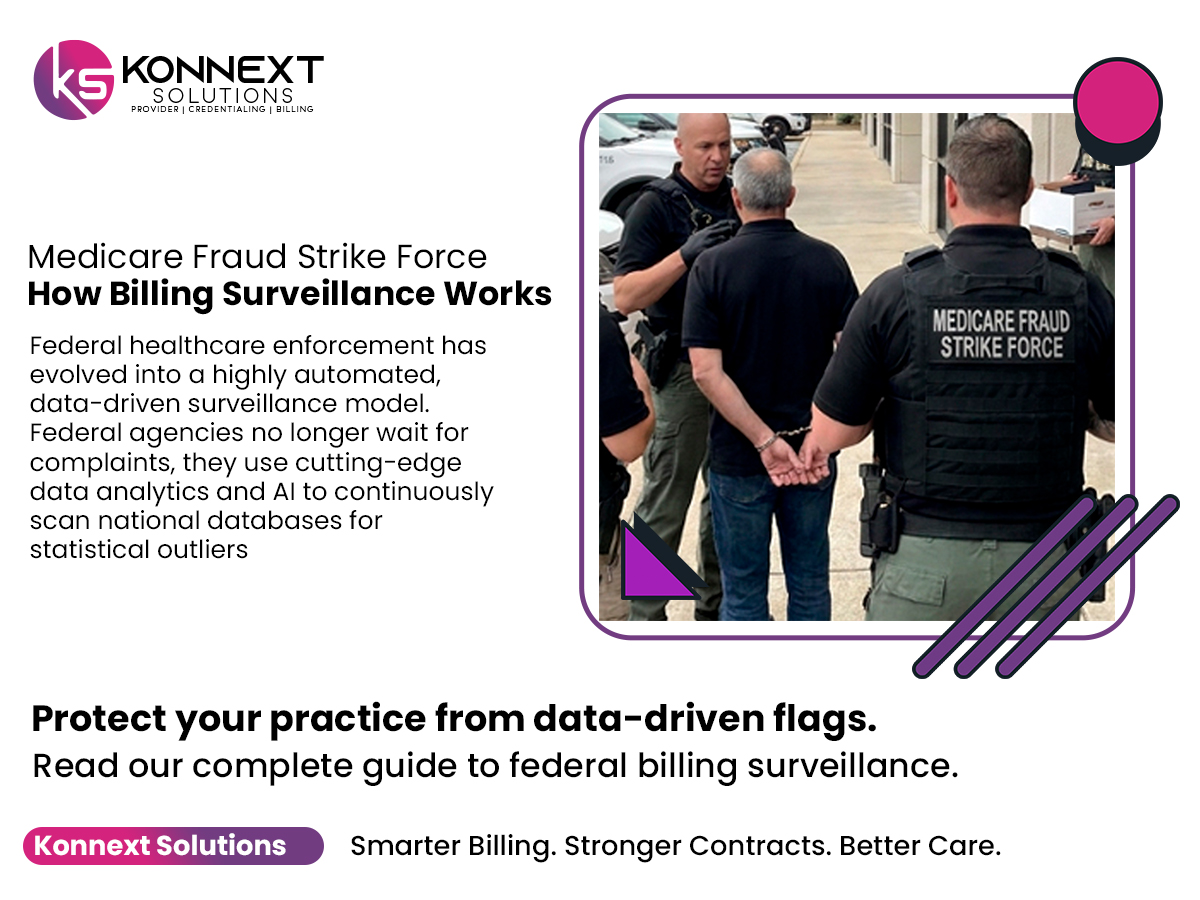
In 2026, Medicare enforcement is no longer just about catching obvious fraud after complaints or investigations. The system has shifted into a technology driven monitoring model where billing behavior is continuously analyzed across national databases.
Federal agencies now rely heavily on data patterns to identify risk early. This means a provider can be reviewed not because someone reported them, but because their billing activity does not match expected norms for their specialty.
This change has made compliance a data issue as much as a legal one.
What the Medicare Fraud Strike Force Does Now
The Medicare Fraud Strike Force operates as a joint federal effort led by agencies such as Centers for Medicare & Medicaid Services, U.S. Department of Justice, Federal Bureau of Investigation, and U.S. Department of Health and Human Services Office of Inspector General.
While it originally focused on investigating confirmed fraud cases, its modern role is broader and more preventive. It now works as part of a national program integrity framework that monitors Medicare billing behavior across the country.
Instead of reacting only after losses occur, the system now tries to detect irregular patterns before they become large scale problems.
How Providers End Up on Federal Radar
Most investigations do not start with direct accusations. They start with data.
Medicare billing data is constantly evaluated using analytics that look for:
- Unusual billing increases compared to similar providers
- Coding patterns that differ from specialty benchmarks
- Repeated high intensity service billing
- Irregular combinations of procedures and diagnoses
- Unexpected spikes in reimbursement trends
- Network patterns between referring and receiving providers
If the system identifies unusual behavior, the provider may be moved into deeper review stages.
At this stage, there is no conclusion of wrongdoing. It is purely a statistical alert process.
Areas Under Strong Scrutiny in 2026
Federal enforcement attention is currently concentrated on specific billing sectors where misuse or inconsistency is more likely to appear in data:
Virtual and Telehealth Services
- Remote visit documentation gaps
- High volume virtual billing without strong clinical records
- Remote ordering patterns that lack clear justification
Medical Equipment and Supplies
- Repeated billing for durable medical equipment without updated patient need
- High frequency supply replacements
Wound Care Services
- Expensive skin related treatment billing trends
- High cost procedure clustering that exceeds norms
Home Health and Hospice
- Eligibility documentation inconsistencies
- Repetitive certification structures across large patient groups
Chronic Condition Coding Patterns
- Diagnosis coding that consistently leads to higher reimbursement
- Billing patterns that differ significantly from peer averages
How This Is Different From Normal Audits
Traditional audits usually review a small set of claims from one payer.
The modern federal model works differently:
- It reviews Medicare data across multiple programs
- It compares providers against national benchmarks
- It identifies risk through predictive analytics
- It flags providers before claims are individually examined
This means review can begin at a statistical level, not at a claim level.
A provider may be flagged simply because their billing profile stands out from expected patterns.
What Happens After a Provider Is Flagged
Once a provider is identified as a potential outlier:
- Analysts review billing data in detail
- Patterns are confirmed or dismissed
- If risk is supported, a formal review may begin
- Administrative actions can follow if needed
Possible actions include:
- Temporary payment suspension
- Prepayment review requirements
- Restrictions on billing privileges
These steps can occur before any legal charges or court process.
Why Legitimate Providers Can Still Be Flagged
A key misconception is that only fraudulent providers are targeted early.
In reality, the system does not start with intent. It starts with patterns.
A legitimate practice can be flagged due to:
- Aggressive coding habits
- Standardized templates that increase coding levels
- Billing strategies focused heavily on maximizing reimbursement
- Documentation that does not fully support service intensity
- Rapid growth in certain service categories
Even if everything is done without harmful intent, unusual statistical behavior can still trigger review.
What Medical Practices Should Be Doing
Modern compliance requires ongoing internal monitoring, not occasional audits.
Practices should regularly evaluate:
- Changes in CPT code distribution over time
- How coding compares to specialty benchmarks
- Modifier usage consistency and justification
- Growth in telehealth, DME, and chronic care billing
- Whether documentation supports billed service levels
- Sudden revenue shifts not explained by patient volume
The goal is to ensure billing patterns reflect real clinical activity clearly and consistently.
Role of Billing Vendors in Compliance Risk
Many billing risks begin with external billing support.
If a billing team focuses heavily on increasing revenue without strong documentation alignment, it can unintentionally create:
- Outlier billing patterns
- Benchmark deviations
- Aggressive coding trends that stand out in data systems
Even if the provider is not directly involved in these decisions, responsibility ultimately remains with the provider organization.
Final Takeaway
The Medicare Fraud Strike Force has evolved into a data driven surveillance system that identifies billing risk through national pattern analysis.
This means compliance today is not only about avoiding fraud. It is about ensuring your billing data consistently matches real clinical activity and does not create statistical red flags in federal systems.
Practices that monitor their own billing behavior are significantly better positioned to avoid disruption.
About Konnext Solutions
Konnext Solutions works with healthcare providers on billing, credentialing, and revenue cycle support. Our focus is helping practices maintain accurate, well structured billing systems that align with payer requirements and reduce exposure to compliance risks while supporting stable reimbursement performance.