
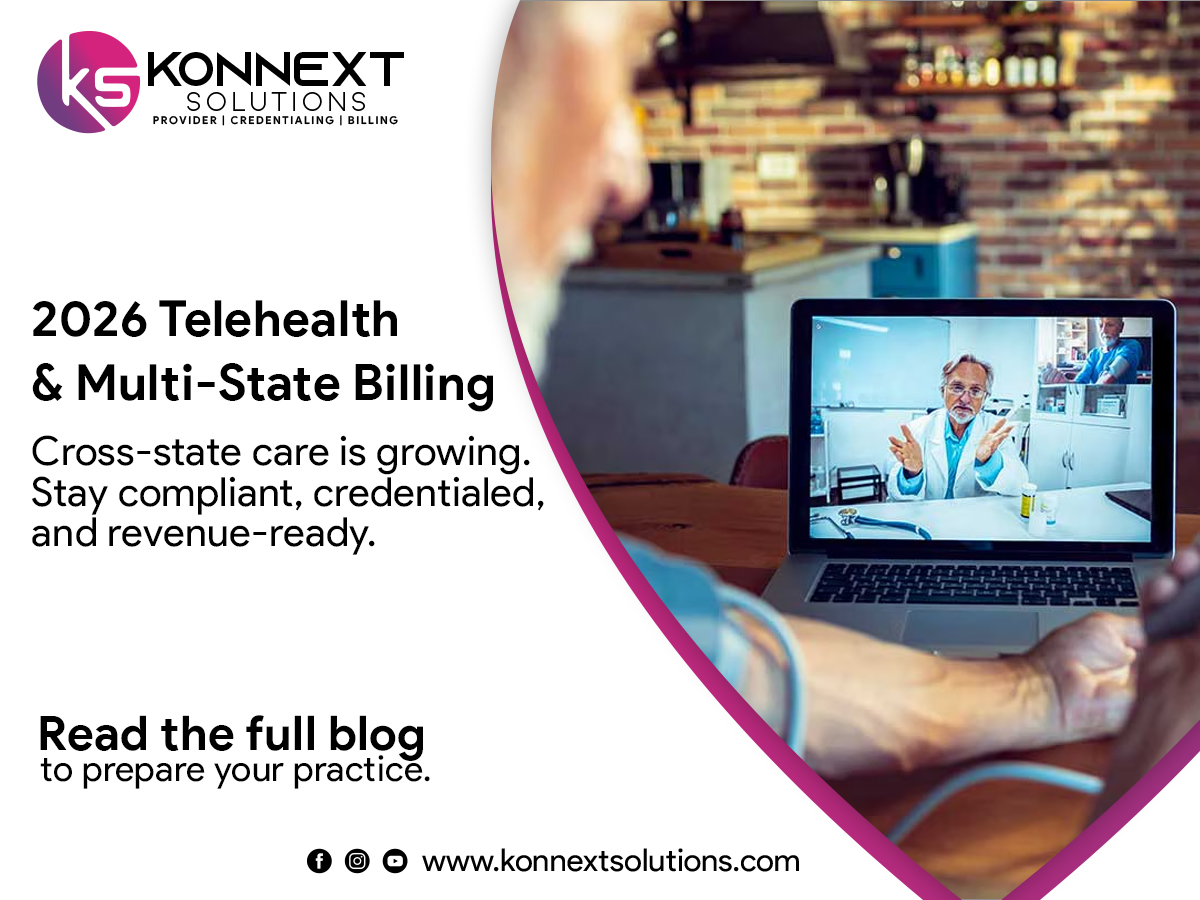
As telehealth continues to grow and provider mobility across state lines becomes more common, 2026 is shaping up to be a pivotal year for multi-state licensing and its impact on billing, credentialing and revenue cycle management. For practices expanding their reach or offering virtual care across jurisdictions, staying ahead of regulatory changes and billing implications is critical.
Why Multi-State Licensing Matters for Telehealth & Billing
- With the adoption of interstate licensing compacts (like those for telehealth) and evolving state licensure rules, providers are increasingly working across state borders.
- Virtual care blurs traditional location boundaries, meaning a provider’s licensing state, the patient’s location, and the billing entity may all reside in different jurisdictions.
- Billing implications are significant: payer rules vary by state, place-of-service codes change, reimbursement rates differ, and credentialing delays can stall claims.
- Credentialing providers for multiple states impacts payer enrollment, billing entity registration, payer contracts, and ultimately claim acceptance.
Key 2026 Trends & Changes to Monitor
More State Participation in Licensing Compacts
Several states are expected to join multi-state licensing agreements in 2026, expanding provider practice mobility. Practices must monitor each state’s credentialing requirements, continuing education mandates, and reciprocity rules.
Telehealth Expansion Across State Lines
Payers and regulatory bodies are loosening restrictions on telehealth across state borders, which means:
- Less reliance on originating site requirements
- More cross-state patient service scenarios
- Greater need for accurate place-of-service and modifier coding
Credentialing & Enrollment Complexity Increases
As multi-state operations expand, credentialing teams face:
- Multiple payer applications across states
- Varying licensure verification and primary source checks
- Increased scrutiny on virtual care billing, including location and provider licensure
Billing & Reimbursement Adjustments
- Place-of-service (POS) codes for telehealth may be updated to reflect cross-state care.
- State-specific payer fee schedules will apply more often as providers operate in multiple locales.
- Payers may audit telehealth claims with cross-state licensing scenarios more aggressively.
Documentation and Compliance Demand Grows
To support billing across state lines and telehealth, practices must be ready with:
- Clear documentation of provider licensing in the state where the patient is located.
- Credentialing evidence for each state of practice.
- Billing workflows that account for different state laws, payer policies, and reimbursement rules.
How Konnext Solutions Supports Your Practice in This Transition
At Konnext Solutions, we help practices navigate the billing implications of multi-state licensing and telehealth expansion. Here’s how:
- We track licensure requirements state by state, ensuring your providers are credentialed where their patients are located.
- Our team maintains updated payer contract and fee-schedule data across states, helping align your billing strategy accordingly.
- We ensure your billing workflows reflect correct place-of-service codes, modifiers and telehealth billing rules for cross-state care.
- We support credentialing and payer enrollment across multiple states, reducing delays and enabling faster revenue capture.
- We audit your telehealth claims workflows to identify risks: licensing mismatches, incorrect billing entity registrations, misapplied POS codes.
Practical Steps for 2026: What Your Practice Should Do
- Map your provider locations and patient states: Identify where your providers are licensed and where your patients are located.
- Review state licensure compacts and reciprocal rules: Check if your state is joining or expanding multi-state licensing participation.
- Update your billing system: Ensure that POS codes and modifiers reflect cross-state telehealth scenarios.
- Revise credentialing workflows: Add multi-state tracking, payer-specific licensure checks, and virtual-care credentialing requirements.
- Train staff on billing and documentation for telehealth: Emphasize licensure verification, patient location documentation, cross-state rules.
- Monitor denial patterns: Pay special attention to telehealth claims, cross-state billing issues, and payer rejections due to licensure or POS errors.
- Partner with a specialized billing & credentialing vendor: Outsourcing may help you scale multi-state operations while maintaining compliance.
Your Compliance Partner for 2026 and Beyond
Konnext Solutions ensures that your billing and credentialing operations stay ahead of payer audits and regulatory shifts. With our expertise, your practice gains transparency, consistency, and confidence in every claim you submit.